

Everything You’ve Ever Wanted to Know About Decaffeinated Coffee Beans
Originally published: 02/05/21 — Updated: 30/10/25
Decaffeination is the process of removing caffeine from something—in this case, coffee beans. A common misconception is that decaf coffee contains no caffeine at all. In reality, it’s almost impossible to remove all of it. In fact, under FDA regulations, coffee only needs to be 97% caffeine-free to qualify as decaffeinated.
But why do people choose decaf? How does it affect flavour and quality? And are there any downsides or important considerations? Let’s take a closer look.

What Exactly Is Decaffeinated Coffee?
Decaffeinated coffee (often shortened to “decaf”) is coffee that’s had at least 97% of its caffeine content removed. This can be done in a few different ways, typically involving water, organic solvents, or carbon dioxide.
1. Using a Solvent
Two common solvents are used in decaffeination: methylene chloride and ethyl acetate.
- Methylene chloride is a chlorinated hydrocarbon (often used in paint removers and pharmaceuticals) but is approved as safe for decaffeination in small quantities. It’s effective but not considered the most natural approach, and many people prefer to avoid it due to its synthetic nature.
- Ethyl acetate is a natural compound often derived from fermented sugarcane. While technically natural, large-scale production usually requires synthetic processing. It also imparts a slightly fruity note to the coffee, which some roasters may see as undesirable depending on the intended flavour profile.
2. The Carbon Dioxide (CO₂) Method
This method involves soaking green coffee beans in water, then placing them in a high-pressure chamber filled with liquid carbon dioxide. The CO₂ binds to caffeine molecules and draws them out.
This is a natural method that doesn’t alter the coffee’s flavour, but it’s very expensive and energy-intensive. As a result, it’s less commonly used—mainly by large producers who can justify the cost.
3. The Swiss Water Decaffeination Method
Arguably the most well-known and environmentally friendly process, the Swiss Water® Process uses only water, temperature, and time—no chemicals whatsoever.
This method begins by soaking green coffee beans in hot water to dissolve caffeine and other soluble compounds (like sugars and oils). The water then passes through a charcoal filter that captures only the caffeine. What remains is a flavour-rich solution called Green Coffee Extract (GCE).
The next batch of beans is soaked in this GCE. Because the solution is already saturated with flavour compounds (but not caffeine), only the caffeine is extracted—leaving the rest of the coffee’s natural taste intact.
It’s a completely chemical-free, certified organic and Kosher process that’s also incredibly sustainable. The GCE is reused, producing minimal waste and outstanding flavour retention.
At Horsham Coffee Roaster, this is our preferred method for creating decaffeinated coffee because we believe it best preserves cup quality.

Why Not All “Natural” Methods Are Truly Natural
Although CO₂ and ethyl acetate are naturally occurring compounds, the reality is that they must often be industrially produced at scale, which comes with environmental impact.
Water, by contrast, is the greenest solvent. Known as the “universal solvent,” it’s safe, sustainable, and effective at extracting caffeine. That’s why the Swiss Water method is considered the cleanest option both environmentally and from a flavour preservation standpoint.
Specialty Decaf: Taste, Ethics & Quality Control
At Horsham Coffee Roaster, our decaf coffee isn’t just about removing caffeine—it’s about retaining everything that makes great coffee great.
We work with import partner DR Wakefield to source high-quality, ethical green coffee for decaffeination. This ensures that our beans come from sustainable farms and producers paid fairly for their work.
Once the coffee is decaffeinated (usually via the Swiss Water process), we roast it on our low-emissions Loring roaster using the same care and quality control as all our other coffees. That means you’re still getting the full specialty experience—minus most of the caffeine.
It’s true that our decaf is more expensive than the mass-produced alternatives you’ll find in supermarkets. But we believe that transparency, sustainability and cup quality are worth it—and our customers agree.
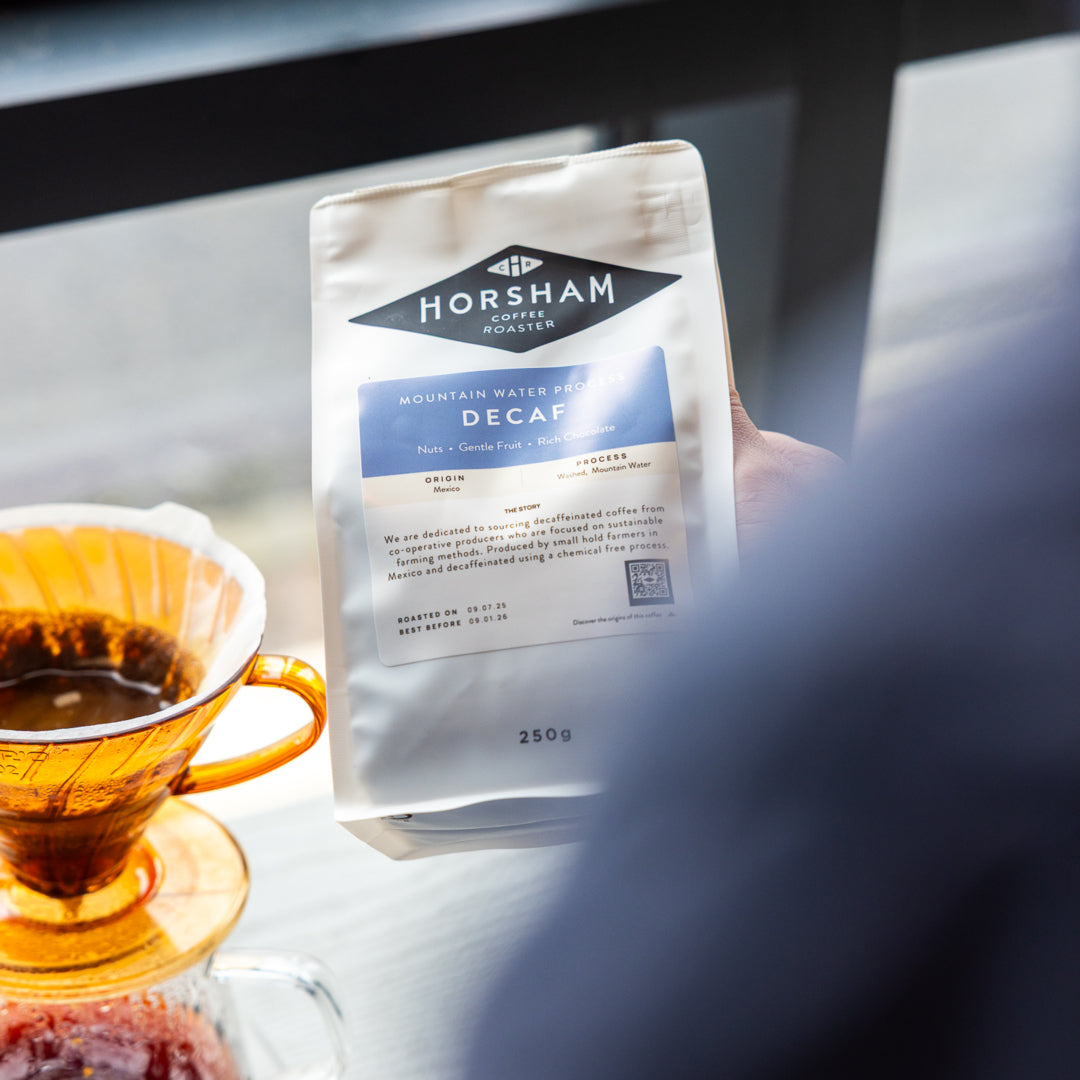
Looking for Better Decaf?
If you want a decaf that’s:
- Free from chemical solvents
- Roasted with care
- Ethically sourced and transparently traded
- Delicious and full of flavour
…then our Decaf is for you. Available in 250g, 1kg and 2.5kg bags.
